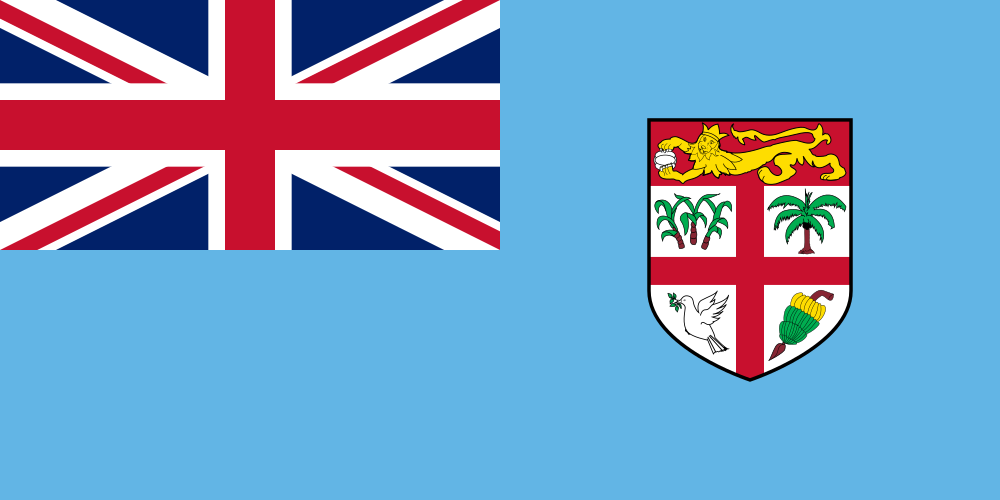
Un relato sobre la creación de la bandera de Fiji.
Fiji's flag: how our noble banner blue came to beBy Sophie Foster
Sunday, October 12, 2008
THE year was 1970, and across the country there was a frenzied rush. The Queen had allowed the Fiji Independence Order on September 30th, which would come into effect just 10 days later. It didn't allow for much time to get ready, but in two aspects at least Fiji was raring to go. One was the new national anthem. The other was the national flag.
Just months before, Tessa Mackenzie was one of the thousands who heard about the national competition to find Fiji's new flag.
At the time she was a volunteer teacher in Veiuto, taking an art and craft class with primary school children.
The prospect of designing the new national flag excited her, and she set about finding out more about how such flags are designed.
Little did she know that her idea would result in one of the proudest moments of her life, watching her design being lifted to signal the start of a new nation. As she thought about what to put on the Fiji flag, Mrs Mackenzie says she wanted to keep something of Fiji's history in the design she submitted.
Her starting point was the national coat of arms, which has two Fijian warriors on either side of a shield.
"The shield I think was designed around 1906 by Lady Imthurne and she had put in several items with the idea that Fiji has a future in the new world. Coconuts did for a long time drive the economy of Fiji and bananas used to be great economic crop and of course sugar cane is still important. There was also the dove of peace, which was on Ratu Cakobau's flag before cession," Mrs Mackenzie says. Funnily enough, she says that if the coat of arms had been a bit fussier as in if it had more intricate designs in it she probably would have chosen something else to use for her national flag submission.
As for the inclusion of the Union Jack, Mrs Mackenzie says the decision to include it came about because that seemed to be how everyone was feeling at the time, sentimental about the past, optimistic about the future.
"This was the mood of the time," she says.
Her choice of colour for the background of the flag, she says, was an attempt to show "a pale blue background to represent the sea".
Unbeknown to her, at the same time, another man Robi Wilcock was also thinking along the same lines.
In fact, he and Mrs Mackenzie submitted exactly the same design to the competition.
"I knew Robi Wilcock but we worked separately on the flag idea. I was pleasantly surprised to discover that we had submitted the same idea and that it had been accepted," she says.
In his book, "The Pacific Way: A Memoir", Ratu Sir Kamisese Mara, who was chief minister at the time, explains the decision. "The Fiji national flag had to be designed, and this was done by competition when two entrants Mrs Murray Mackenzie and Mr Robi Wilcock - produced identical designs with the Union flag in the top left quarter and the shield of Fiji's coat of arms in the fly - all on a background of Pacific blue," he says.
He says the choice of pale blue set Fiji apart from its neighbours.
"At independence a visiting dignitary said to me, 'I'm very disappointed to see that you as an Oxford man have chosen Cambridge blue for your flag!' A Cambridge friend of mine is convinced that I still believe he realised this all the time and never said a word. But in fact it differentiated us from the dark blue of a number of our Pacific neighbours."
When the Fiji flag was raised for the first time at Albert Park on October 10, 1970, the ceremony broke somewhat with the norm elsewhere around the world.
"I had seen films of independence ceremonies elsewhere, where the British flag had been lowered at midnight and the new independence flag raised, both to frenzied cheering. I did not think this appropriate to our relationship with the British Crown. We decided to have a final beating of retreat before independence, when the Union flag would be lowered with the quiet dignity and respect our long association warranted. It was a moving occasion," Ratu Mara said.
So it was that after the Union Jack was lowered on October 9, 1970, the way was clear for Mrs Mackenzie's design to be raised the next day as the symbol of a new nation.
Ratu Mara says: "At Albert Park, our ceremony began with a bare flag-pole, and the people were able to show their unrestrained enthusiasm when the Fiji national flag was unfurled for the first time, and thousands of schoolchildren excitedly waved a forest of newly minted Fiji flags".
At that exact moment when the new flag was raised, Mrs Mackenzie watched with emotion from the rooftop of Government Buildings.
"I was standing on the top of the roof because my husband Murray was a civil servant at the time. So we were fortunate that we had a nice view from there," she says. "I remember that I made a dress of pale blue for myself and two pale blue shirts for my sons to wear. I had embroidered my design onto the dress and the shirts, with the Union Jack on one side and the shield from the Coat of Arms on the other. It felt great to just be there watching history unfold. I think it does make a nice flag."
She is also a major advocate for keeping the flag.
"After so many years, this flag has become well known worldwide. It's everywhere tourists T-shirts, documents, international papers ... It symbolises Fiji. If we change it, then we will have lost about 40 years or so of publicity."
In fact, when the National Council for Building a Better Fiji was considering the pros and cons of changing the national flag, Mrs Mackenzie told them just that. "It's our history and you can't ignore it."
Today, though the items have turned the palest of blues, Mrs Mackenzie still has that Fiji Independence Day dress and shirts that she embroidered for her sons. She says she will treasure them always, along with the flag that signalled the start of a new nation